Scroll down to learn more
Your brief is ready.
We've configured a capture brief calibrated to your prompt. Download it as a PDF, take it with you, and return when you've completed your capture.

Brief reference: ZE-S-2026-04887 Method: Smartphone Capture
Credibility window Cycle: 24 Hours Circulation: Social Media
Our benchmark is belief
A successful image for us is one viewers act on before they question it. Below are the cases where the action came before the question.

The "Migrant Mother"
Dorothea Lange's 1936 photograph of Florence Owens Thompson with three of her children, taken at a pea-pickers' camp in California, became the defining image of Depression-era American poverty. Lange's caption identified the subject only as a thirty-two-year-old destitute pea picker, mother of seven, living on frozen vegetables and birds the children had killed. Thompson, who had not consented to the photograph and was not informed it would be published, spent the rest of her life rejecting both the framing and the use of her image. Her account was recorded but did not displace the original framing.

The Pentagon explosion
A fabricated AI image showing a large explosion near the Pentagon was posted to a verified Twitter account in May 2023. The image was reposted by accounts with hundreds of thousands of followers. Within minutes, the S&P 500 dropped briefly before recovering when the image was identified as synthetic. No real event had taken place. The financial response preceded the verification by approximately ten minutes.
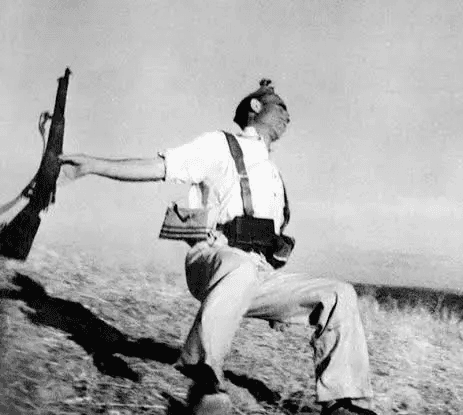
The Falling Soldier
Robert Capa's 1936 photograph of a Spanish Republican militiaman apparently struck at the moment of death became one of the most reproduced war photographs of the twentieth century. From the 1970s onward, sustained scrutiny — location analysis, related frames, and Capa's own inconsistent accounts — produced serious and unresolved doubt about whether the moment was real. The image has remained canonical throughout. Fifty years of scrutiny. No resolution. The photograph kept its place.
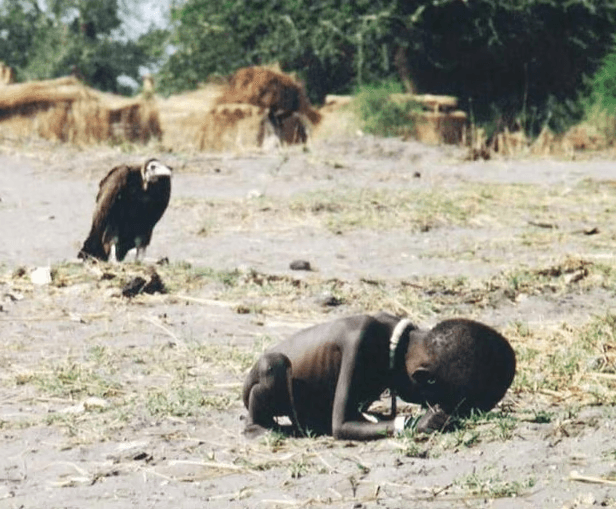
The starving child and the vulture
Kevin Carter's 1993 photograph of a Sudanese child collapsed near a vulture won the Pulitzer Prize for Feature Photography. The caption framed it as a girl stalked by a predator while photographers watched. Subsequent reporting established that the child was a boy, supervised at a UN feeding station, and survived the moment by years. The vulture was there for unrelated reasons. The image was real. Every claim attached to it was wrong.

Iran - USA War
During the Iran-USA war of Feburary 2026, AI-generated images and videos of strike damage circulated across TikTok, Facebook, and X. A photograph claiming to show the destruction of US Base in Bahrain reached millions of viewers before being identified as synthetic. AI-generated aerial videos of supposed strikes drew tens of millions of views on single posts. The fabrications continued to circulate after identification, often on the same platforms that had flagged them.

Los Angeles Times — Brian Walski
A senior staff photographer at the Los Angeles Times composited two photographs taken seconds apart during the early days of the Iraq War, combining a British soldier and an Iraqi civilian into a single more dramatic frame. The composite ran on the front page and was syndicated to other papers. Within forty-eight hours a Hartford Courant editor noticed two civilians appearing twice in the published image and identified the manipulation. Walski was fired. The image had already appeared in print runs of several million copies. Identified in forty-eight hours. The print run had already shipped.

The image that won
A black-and-white image titled Pseudomnesia: The Electrician, depicting two women in mid-century European dress, won the Creative category of the Sony World Photography Awards in April 2023. The image was judged by a professional photography panel, exhibited at Somerset House in London, and accepted into the competition catalogue as a winning photograph. It had been generated by DALL-E 2. The artist, Boris Eldagsen, accepted the prize on stage and then publicly refused it, declaring that the image was AI generated.